
Am I always the one who texts first?
Count conversation openings over two to three weeks, then separate who starts from who keeps the reply going.
One thread can't answer this. Count who opens each conversation over two to three weeks. Then check the next two exchanges: someone can rarely start and still turn toward you warmly. If you start almost every conversation and get little back, that's a real imbalance. Don't stop texting first as a test. Say it plainly, or pause once without scoring.
Count openings, not messages
If you're asking "Am I always the one who texts first?", the honest first step is to stop scrolling at 1 a.m. and count. An opening is the message that starts a conversation after a gap of a few hours, not every message you send. Pick two to three weeks, or longer if you have it, and tally who opens.
- Count text openings. Write down who sends the first message after each quiet stretch. Look for a clear, sustained majority over the whole window, not one bad week.
- Count openings that never happened by text. A call, a "want to get food?", the person who books the birthday dinner but doesn't message. If they start in other ways, the text tally undercounts them.
- Notice the time of day. Someone who only writes at 11 p.m. may be a night texter, not a reluctant one.
- Write the tally down. The feeling that you always text first comes from memory, and memory feels like always when you're anxious. A number you can look at is different.
One message is weak evidence. The split showing up week after week across openings, and not just in this thread, is strong evidence.
The second score: what happens after you open
Who starts is only half the question. After you open, watch the first two exchanges.
Opening a chat is a small bid for connection, and what matters most is whether the other person turns toward it or away 1. Look at what they do with your opening: do they reply properly, ask something back, keep the thread going, or close it with a flat answer?
- High initiation + high engagement is lopsided but warm. You start, they turn toward you. That is a texting style, not neglect.
- High initiation + low engagement is the pattern to take seriously. You open, they answer in one line, and the chat dies unless you revive it.
What people actually say in texts is linked to relationship satisfaction, not just how often they message 2. So look at the words, not only the count. If their replies are warm one day and cold the next, that's a different question: how to understand mixed signals.
hey, how did the thing go?
omg it was fine actually good
tell me everything
haha ok so they asked about the project and i panicked but recovered
proud of you. what are you doing tonight?
probably just eating. you?
What always texting first does not mean
Before you decide something is wrong, give the innocent explanations their weight.
- Some people find starting harder than replying. It's habit, not reluctance. They may not have been the one to ring friends either.
- Some hold back because they don't want to bother you. Your first message reads as permission to talk.
- Someone can initiate constantly in person and almost never in text. A partner who plans the weekend and never opens the chat is still reaching toward you.
- Going quiet can be overwhelm, not indifference. Some people shut down when flooded 3.
- Patterns settle. If you have always opened, the other person may have learned they don't need to.
One hard week is a deadline or a bad stretch. A split that holds for months is a pattern.
When the imbalance is the real problem
Initiation imbalance matters most when it's part of a wider one-sided pattern. You are not just first; you are also the one asking the questions, suggesting the plans and smoothing things over afterward.
- The engagement score is low too: short replies, no questions back, conversations that die unless you revive them.
- You feel relief on days you decide not to write, rather than missing them.
- When you raise it, the response is annoyance or a brush-off, not curiosity.
- No one else in your life requires this much effort to reach.
This is the fuller version of how to spot a one-sided conversation: count starts, questions, plans and repairs, and see whether the whole workload is yours.
guess what happened today
what
got the callback. they want me for friday
nice
you around this weekend?
busy
Should you stop texting first?
Ask what stopping is for.
- If the answer is "so they notice and chase me", that is a test. Tests usually produce resentment on both sides, and they tell you more about your anxiety than about the other person.
- If the answer is "I want to see what happens when I stop carrying this alone", that is information you are allowed to have.
If you pause, do it once, unannounced, for a defined stretch. Three days is enough if you talk daily; a week if it's looser. Don't fill the gap with indirect hints, stories or messages to mutual friends.
Whatever happens, treat it as data, not a verdict on your worth. If nothing comes at all, that's a conversation to have, not a reason to go cold for a month. One pause doesn't disprove a genuine relationship; one warm message in the gap doesn't prove one either. Look at what follows over the next weeks.
If you find yourself checking the chat constantly and the worry is interfering with your day, that's not a texting question. Occasional worry is normal; persistent checking can be something else 4.
If not replying or replying to the wrong person is punished, or if a pause could provoke someone unsafe, don't use a pause. Talk to someone you trust or a helpline.
What to say instead of going quiet
Most of the time, saying it plainly works better than a silent experiment.
Name the observation, not the accusation: "I've noticed I'm usually the one who starts our chats." Ask a real question: "Is that just how you are with texting?" State the preference once: "It would mean something to me if you started sometimes."
Leave room for an answer that isn't about you. A lot of people have never been asked this. If you've been quiet and they ask why, answer honestly rather than pretending you were busy.
Then watch the next two weeks rather than the next reply. People who care often adjust, even clumsily. If nothing moves after you've asked plainly, that is information too.
i've noticed i'm usually the one starting our chats. is that just how you are with texting, or is something off?
hey, i feel like i'm always the one texting first. could you start sometimes? it would help me feel like you want to talk
Where Vermilleon helps
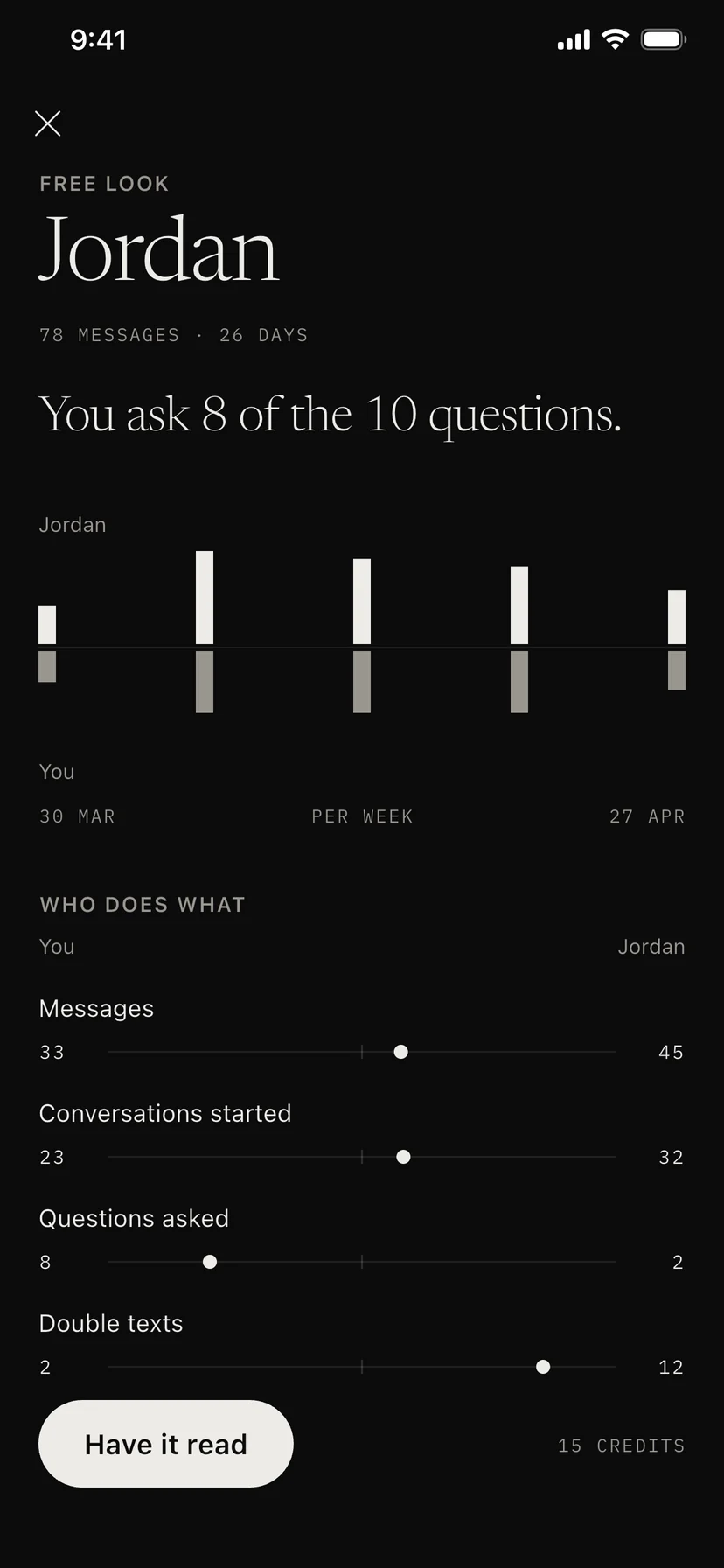
The free look answers this question directly. Bring in a chat you're part of, with their consent, and Vermilleon counts who starts conversations, who sends more, who asks the questions, and who double texts. It's free for every new chat, and nothing is read by AI. For reply times, use an export with timestamps; screenshots give message counts only.

Questions people ask next
- How long should I wait before texting them again?
- Don't set a fixed wait to provoke a reply. If you normally talk daily, give it a day or two while you do something else. If you're trying to see what happens when you don't start, one unannounced pause of three days to a week is enough. The point is information, not punishment.
- Does double texting make me look desperate?
- A second message after a genuine gap is normal, especially if it adds something new or follows up on a plan. Desperation isn't sending twice; it's sending repeatedly with no reply, or keeping score to see who breaks first. If you're sending a third or fourth with no answer, stop and notice how that feels.
- What if I stop texting first and they never text me at all?
- Then you have useful information: the conversation ran on your effort, at least over text. It doesn't prove they don't care, because some people are terrible at initiating. But it does mean you need to decide whether you can accept that pattern or want to address it directly.
- Is this different if we're just dating versus already together?
- Early dating often has softer rules because both people are testing the water, but the same two scores apply: initiation and engagement. In an established relationship, lopsided initiation usually matters more because the pattern has had time to settle in and reflect real effort distribution.
- How do I stop keeping score without ignoring what I need?
- Decide what you need, like them starting once a week, and ask for it once, plainly. Then stop tallying every message. Set a review point in two to three weeks. If the need is still unmet after you've asked, that's a conversation about compatibility, not a scoreboard.
Sources
- Turn Towards Instead of Away, The Gottman Institute
- Using Technology to Connect in Romantic Relationships: Effects on Attachment, Relationship Satisfaction, and Stability in Emerging Adults, Journal of Couple & Relationship Therapy (2013), Schade, Sandberg, Bean, Busby and Coyne
- The Four Horsemen: Stonewalling, The Gottman Institute
- Anxiety Disorders, National Institute of Mental Health
Vermilleon Editorial · Published 18 Oct 2026 · How we write these →