
How to spot a one-sided conversation
Count four things across a few weeks of messages. The answer is in the split, not in any one text.
A conversation is one-sided when one person does most of the starting, asking, planning and repairing, and the other mostly responds. One quiet week isn't the sign. The sign is the same split showing up week after week, across all four, while the other person stays pleasant but rarely reaches toward you.
Count four things, not one
If you're trying to work out how to spot a one-sided conversation, start by counting rather than rereading. Rereading one message at 1 a.m. tells you about your mood. Counting across weeks tells you about the conversation.
- Who starts. Count the first message after every gap of a few hours. Opening nearly every conversation, week after week, is a pattern. Opening a few more than they do is ordinary variation.
- Who asks. Questions are how people show curiosity. If your messages end in questions and theirs end in answers, you're carrying the conversation.
- Who plans. "We should hang out" isn't a plan. "Thursday at 7?" is. Notice who turns interest into a time and a place.
- Who repairs. After a tense moment or a long silence, who reaches out first, and who names what happened?
One message is weak evidence. A split that holds across all four, for weeks, is strong evidence.
What it usually looks like
One-sided conversations are rarely rude. The other person replies, often warmly. What's missing is reach: they answer the question you asked and stop there. Plans happen when you push and quietly dissolve when you don't. Their good news arrives because you asked about it, not because they wanted to tell you.
The giveaway is often what happens when you stop. If you skip a day of starting the conversation and the chat simply goes quiet until you return, the conversation was running on your effort.
how was the interview??
good
yay!! what did they ask
just normal stuff haha
well i'm proud of you. celebrate this weekend?
maybe! this week is crazy
What it doesn't mean
Some people text in short bursts and talk properly in person. Some go quiet through exams, night shifts, illness or grief. Some were never taught to ask questions back, and some find texting itself tiring. Different habits are not the same as not caring.
So if the split only shows up in text, or only during one hard month, treat it as weak evidence. Check whether it holds over time and in how you spend time together. Someone who is lopsided over text but present, curious and generous in person is telling you something different from someone who is lopsided everywhere.
How to check it fairly
Pick a window of four to eight weeks and count the four things. Then ask two more questions.
First, has it changed? A split that was always there is a difference in style. A split that appeared recently is a change, and changes usually have a reason worth asking about.
Second, what's your part? If you reply within seconds and fill every silence, the other person may never get the chance to start. Leaving a little room for a week is a fair test of the pattern, as long as you treat what happens as information rather than a trap they can fail.
What to do about it
Say what you've noticed once, without a scoreboard, and ask for one specific thing. Describing the pattern lands better than labelling the person: "I'm usually the one who plans" is easy to hear; "you never make an effort" invites an argument.
Then watch the next two weeks rather than the next reply. People who care usually adjust, even clumsily. If nothing moves after you've asked plainly, the conversation has given you its answer for now, and you can decide how much more you want to put in.
i've noticed i'm usually the one who reaches out and plans. not keeping score, i just want to know you want this too. could you pick the next plan?
Where Vermilleon helps
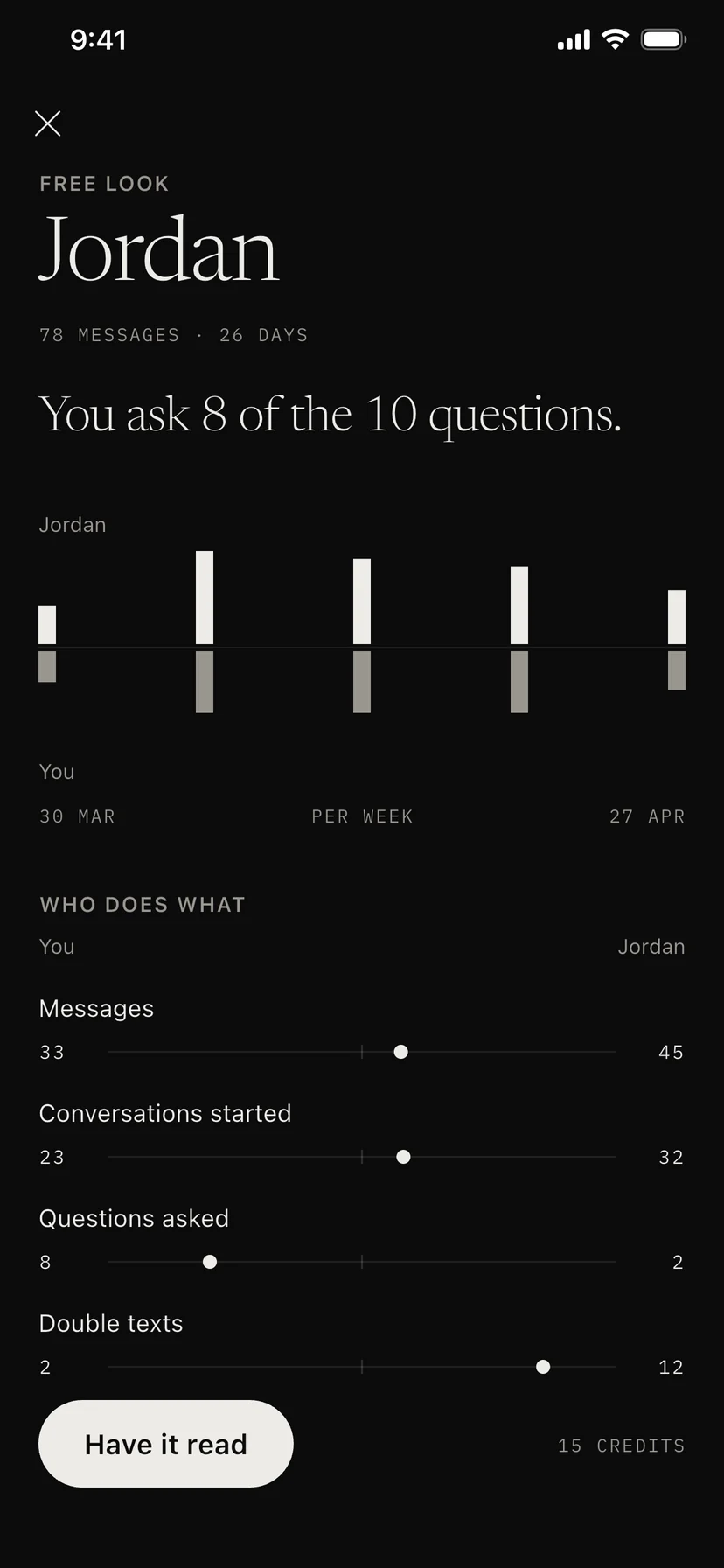
Counting this by hand across months of messages is slow, and hard to do fairly when you're upset. Vermilleon's free look does the counting: bring in a chat you're part of, with their consent, and see who starts conversations, who asks the questions, who double texts and how fast each of you replies. It's free for every new chat, and nothing is read by AI. With a subscription, the read shows who carries the conversation and what that costs you.

Questions people ask next
- Is it one-sided if I just text more than they do?
- Not on its own. Volume depends on style: some people send five short texts where others send one long one. Starting, asking, planning and repairing tell you more than message counts, because they show who is reaching toward the other person rather than who simply types more.
- How far back should I look?
- At least three or four weeks, ideally a few months. You're looking for a split that holds steady, not one stretch when life got busy. If you can, compare an early month with a recent one: a split that appeared recently says something different from one that was there from the start.
- Should I stop texting first to see if they notice?
- You can leave more room, but treat it as information, not a test they can fail. When you go quiet, some people won't notice for reasons that have nothing to do with you. Saying what you've noticed and asking for one specific thing usually tells you more, and faster.
- Can a friendship be one-sided too?
- Yes. The same four counts work for friends, family and colleagues. With friends the clearest signs are plans and check-ins: who suggests meeting, who remembers the thing you mentioned, who asks how it went. Many one-sided friendships feel fine in person and lopsided only in text.
Vermilleon Editorial · Published 17 Oct 2026 · How we write these →