
They say they're interested but never make plans
One concrete invite separates plans from talk. A counter-offer counts; warmth with no date doesn't.
Interest is words; a plan is a date. If you've only said 'we should', you haven't made an offer. Send one invitation with a time and place, then sort the reply: yes with a time, no plus an alternative, or warmth with no date. Two warm, dateless replies give you your answer—stop offering.
The short answer: interest is words, plans are behaviour
If you're asking 'says he likes me but never makes plans', you're not really asking about a plan. You're asking whether the words are backed by anything. 'I like you' and 'Thursday at 7?' are different kinds of statement. The first costs nothing and is easy to mean; the second commits time, which is why it's the more honest signal.
Before diagnosing their side, check yours. If every invitation you sent was 'we should hang out sometime', you haven't given them a concrete slot to accept. Vague offers get vague answers from interested and uninterested people alike. This is the narrow version of what someone says versus what they do. The rest of this page is one test with a stop rule, so the answer comes from their reply rather than another reread of the thread.
The one-offer test
Make the offer concrete and low-cost: a day, a time, a place, and an easy exit. 'Thursday, 7, that ramen place — want to? No worries if not.' A specific offer is a bid for connection 1, and it lets a shy or busy person say yes with one word.
Sort the reply into exactly one of three buckets.
- Yes with a time. Plan made.
- No, plus a specific alternative — 'can't Thursday, but Sunday afternoon?'. That counts as making a plan; note who supplied the alternative.
- Warmth with no date — 'omg yes we have to soon'. Only this is the words-versus-plans gap.
When people respond to good news, engaged and specific replies matter more than general positivity 2. The same habit applies here: look for a time or an alternative, not just warmth. Run it a second time two to three weeks later, in a different shape — a weeknight instead of a weekend, a group thing instead of one-to-one, a walk instead of dinner. One reply is thin evidence. Two same-bucket replies in different shapes is a pattern. Then stop offering. Whether they step into the space you leave is the last piece of evidence.
thursday, 7, the ramen place near you - want to? no worries if not
can't thursday, sister's birthday - but tuesday after 7 same place?
tuesday 7 works
cool, i'll book
Not a planner, not a priority, or being kept warm
Three patterns look identical in a thread but call for different responses. What the texts say matters more than how many there are 3.
- Doesn't initiate, but accepts and turns up. Real interest, uneven load. They say yes to everything you propose, arrive on time, and don't originate. The fix is one sentence asking them to take a turn, not leaving.
- Planner-averse. Logistics feel like a chore, or they worry about getting the plan wrong. They counter-offer, suggest a thing rather than a day, and show up. Name it once; don't build a case against them.
- Kept warm. Effort appears when you go quiet and evaporates when you're available; plans exist only on their terms — their time, their place, often late and private; there's no alternative, only enthusiasm. This is all talk, no plans. It can be a slow fade in progress 4.
- Low priority right now. Their week has other things above you, and the calendar keeps saying so while the messages stay warm. Believe the calendar.
These are descriptions of what a thread is doing this month, not verdicts on who someone is. If the planning split also shows up in who starts, asks, plans and repairs, see how to spot a one-sided conversation.
thursday 7 ramen place? no worries if not
yesss i'd love that, work is insane right now
ok, let me know a day that works
soon i promise, work is insane rn
wednesday evening walk, 6.30, the park? easy out
omg we have to soon. i promise
What it doesn't mean
Before you conclude anything, give the innocent explanations room.
- A genuinely overloaded stretch — exams, a sick parent, a deadline — usually still produces a date at the far end ('after the 12th I'm free'). No anchor at all is the difference between busy and unavailable.
- Anxiety about proposing, or about being rejected, looks like disinterest over text. Anxiety is common 5. For some people, anxiety about proposing or being rejected can make committing to plans harder.
- They planned the last two or three meetings. They may simply be waiting to see whether you will.
- A different script. Some people grew up with one person proposing and the other accepting. That's a habit, not a verdict.
- A fast, breezy 'sounds good' may be meant. Non-committal phrasing isn't always non-commitment.
None of these explanations survive two concrete offers with no date and no alternative. That's exactly why you run the test before concluding anything.
What to do, in order
Tonight, send one specific offer with day, time, place and an easy out. Don't attach a speech about effort to it.
- Write down the date you sent it, their exact reply, and which bucket it fell into. Keep the raw reply, not your reading of it — going back over the thread is what made this feel unanswerable.
- Bucket (b): accept their alternative and let them own the logistics. Bucket (c): wait. Don't fill the silence within the hour, and don't offer again inside the same week.
- Bucket (c) twice: say one plain sentence, as a question, not an accusation — 'I've noticed I'm always the one proposing. I'd rather we took turns — want to pick the next one?' Their answer is the data you've been hunting for.
- Decide on the reply to that sentence, not on the two weeks of warm messages before it. The sentence is the fair test.
- Don't run tests you couldn't admit to: fake plans, cancelling to see if they chase, going silent as a trap. They produce anxiety, not information.
thursday, 7, the ramen place near you - want to? no worries if not
i've noticed i'm usually the one proposing. i'd rather we took turns — want to pick the next one?
When it isn't a scheduling problem
Everything above assumes two people with roughly equal freedom to say yes. If plans only ever happen when, where and how they choose; if asking for a plan gets coldness or punishment; if they discourage you from seeing other people or monitor your phone — that isn't a planning style and it doesn't need decoding 6.
Where Vermilleon helps
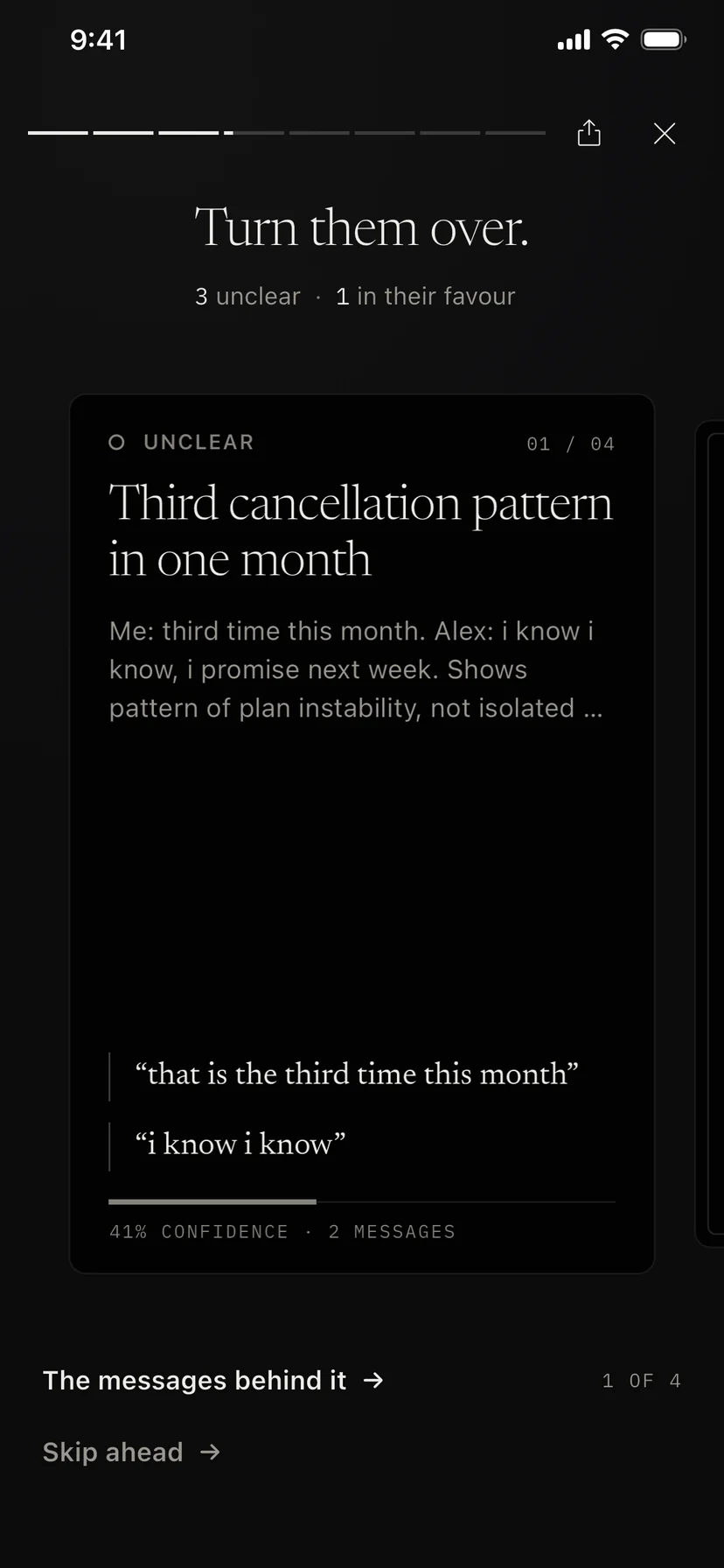
If you bring in a chat you're part of, with their consent, Vermilleon's signals can show the messages behind each finding and mark thin evidence as Unclear or Weak. The their_type read gives a short name for how they text, with the strengths and risks behind it, so 'warm but never lands a plan' becomes a pattern you can see instead of a feeling you keep going back over.

Questions people ask next
- How many times should I ask before I stop asking?
- Twice, in two different shapes, with a real break between. The point of two offers is not to give them more chances; it's to give the pattern a fair test. A genuinely interested person can be busy, anxious or a poor planner once; the second offer catches that. After two warm, dateless answers, making a third offer usually tells you more about your hope than about their interest.
- They text me all day every day — doesn't that count as making an effort?
- It counts as communication effort, but not as planning effort. Daily texting is cheap for some people and real for others; it can also be how someone keeps a thread warm while never committing a slot. The offer test separates 'likes talking to you' from 'will move things to see you'. Someone who texts fifty times a day and never says yes to a date is giving you a clear pattern.
- Should I say something about it, or just quietly back off?
- After two dateless answers, say one plain sentence: 'I've noticed I'm always the one proposing. I'd rather we took turns — want to pick the next one?' Then stop filling the silence. Quietly backing off without a word tests only whether they notice within a few days; the sentence gives them a choice and gives you an answer. It also avoids guessing games.
- Is 'I'm just bad at planning' ever true?
- Yes, often. Some people find logistics overwhelming or fear proposing the wrong thing. The test distinguishes bad planning from low priority: a bad planner will counter-offer, suggest a type of activity, or accept your offer and show up. Someone who only produces warmth and no date, twice, after you've made it easy, isn't giving you a planning problem; they're giving you an answer.
Sources
- Turn Towards Instead of Away, The Gottman Institute
- What Do You Do When Things Go Right? The Intrapersonal and Interpersonal Benefits of Sharing Positive Events, Journal of Personality and Social Psychology (2004), Gable, Reis, Impett and Asher
- Using Technology to Connect in Romantic Relationships: Effects on Attachment, Relationship Satisfaction, and Stability in Emerging Adults, Journal of Couple & Relationship Therapy (2013), Schade, Sandberg, Bean, Busby and Coyne
- Ghosting in Emerging Adults' Romantic Relationships: The Digital Dissolution Disappearance Strategy, Imagination, Cognition and Personality (2019), LeFebvre, Allen, Rasner, Garstad and others
- Anxiety Disorders, National Institute of Mental Health
- Types of Abuse, National Domestic Violence Hotline
Vermilleon Editorial · Published 20 Oct 2026 · How we write these →