
Why does the same fight keep happening?
Same trigger, same two or three moves, same ending. The loop matters more than the topic.
Why does the same fight keep happening? Often, once the same topic keeps returning, the real argument has moved to how you two argue: who escalates, who goes quiet, who apologizes, who brings it up again days later.
Why the same fight keeps happening
Why does the same fight keep happening? Because a repeating argument is a cycle, not a collection of separate incidents. The subject may change: money, chores, a late reply, whose turn it is to plan. The shape doesn't. Same trigger, same two or three moves, same ending.
The topic is usually the doorway, not the room. Underneath is a need neither of you has said plainly yet. "Tell me before you're overwhelmed." "Answer me when I'm anxious." The fight keeps circling because the ask keeps arriving in the wrong words.
What separates couples who keep having the same argument and stay close isn't avoiding conflict. Repair attempts after a tense moment matter more than avoiding the conflict altogether 1. Stable couples also show about five positive interactions for every negative one during conflict, with negativity carrying more weight 2. So repetition by itself is not the verdict.
Three layers of the same argument
When the same fight keeps happening, it helps to separate three layers.
- Content. The named subject: money, chores, whose family, how late, who texted last.
- Process. How it goes: who raises their voice, who goes quiet, who follows the other into the next room, who apologizes first, who brings it up again days later.
- Ask. The request underneath, usually for reassurance, notice or relief rather than the thing named.
If the same content keeps coming back, treat the process layer as the thing to argue. Running the content round again won't resolve it. You need to argue the process on purpose: "How do we keep ending up here?" rather than who left what in the sink.
Small bids for connection—a comment, a link, a "look at this"—often carry the ask before it becomes a fight. Noticing which bids get turned toward and which get missed tells you more than the transcript of the fight 3.
you left the sink full again
I said I'd do it later
I shouldn't have to ask
you didn't ask, you just started
because I shouldn't have to
so what do you want me to do
The apology that changes nothing, and the one that changes something
Many repeat fights have a sincere apology at the end, but an apology without change is a reset button, not a repaired loop. A repair attempt can still count—repair is what stops conflict from doing damage 1. But a reset button with no described next step is a common reason the same fight returns on schedule.
Compare two apologies. "I'm sorry, I'll do better" is a promise about a person, not a behavior. "I'm sorry—I go quiet and you're left guessing. Next time I'll say I need twenty minutes instead of disappearing" names the pattern and a next-time move you could observe.
When either of you is flooded, a break of about twenty minutes with a stated return time is the condition for repair, not avoidance 4. Read the wording once and it tells you little. By the third round, it is worth checking whether anything has changed: the first time may be effort, but repeated rounds without a described next step form a pattern.
The say-versus-do test in this guide to mixed signals over text is the same test you need here.
you ignored my message all day
I was working
you always do this
I can't do this right now
so you're just going to disappear again
I'll text you later
What the same fight does not mean
A repeated argument does not automatically mean the relationship is failing, or that you're incompatible. Repetition is ordinary in close relationships; what varies is repair.
- A partner who goes silent mid-fight is usually overwhelmed rather than indifferent. Shutting down is what flooding looks like from the outside 5.
- Families teach different conflict scripts: volume, directness, whether you apologize at all. Neither script is the correct one, and neither is a character flaw.
- A genuinely hard problem with no good answer yet—money, distance, a job, a family obligation—will be argued about repeatedly with nobody at fault.
- Stress, tiredness and a bad week change the volume of the same fight, not its meaning.
- What you can't read out of a repeated argument is intent. "They don't care" or "they're manipulating you" are conclusions the transcript doesn't support.
What to do for the next round
Map the last three rounds in three columns: what happened just before, what each of you did, what each of you actually wanted. Look for the step that never varies.
Then change your second move, not your first. The first move is the trigger; the second is where you have room. Before the next round, name the loop once without attaching a case: "I notice we end up here, and I don't think either of us is trying to."
Ask the ask directly: "What do you want me to do differently next time?" and answer it in behavior, not feeling. Take a break with a return time instead of leaving the conversation open-ended. If the loop only happens over text—misread tone, gaps between replies—say the hard one out loud or on a call.
Then watch the next round or two. The evidence is in whether the loop changes, not in the apology. If you need a way to count who starts, asks, plans and repairs across weeks, this page on one-sided conversations gives a straight method.
i notice we keep ending up in the same place, and i don't think either of us is trying to. can we talk about how it goes instead of the same topic?
i'm sorry i go quiet and you're left guessing. next time i'll say "i need twenty minutes" and come back at nine instead of disappearing.
When the repetition is the answer
If the same thing keeps happening, no repair attempt lands, and nothing shifts after you've named the pattern clearly two or three times, the repetition is information about capacity or willingness—not a puzzle to solve with more effort.
Some recurring conflicts aren't conflicts. If the same fight keeps circling threats, checking your phone, who you're allowed to see or what you're allowed to spend, that's not a texting pattern to decode 6.
Decide on evidence over weeks, not on the last message. Keep the log, but read it as a series. The safety box follows this section with crisis and domestic abuse contacts; if that sounds like your relationship, use it rather than keep analysing.
Where Vermilleon helps
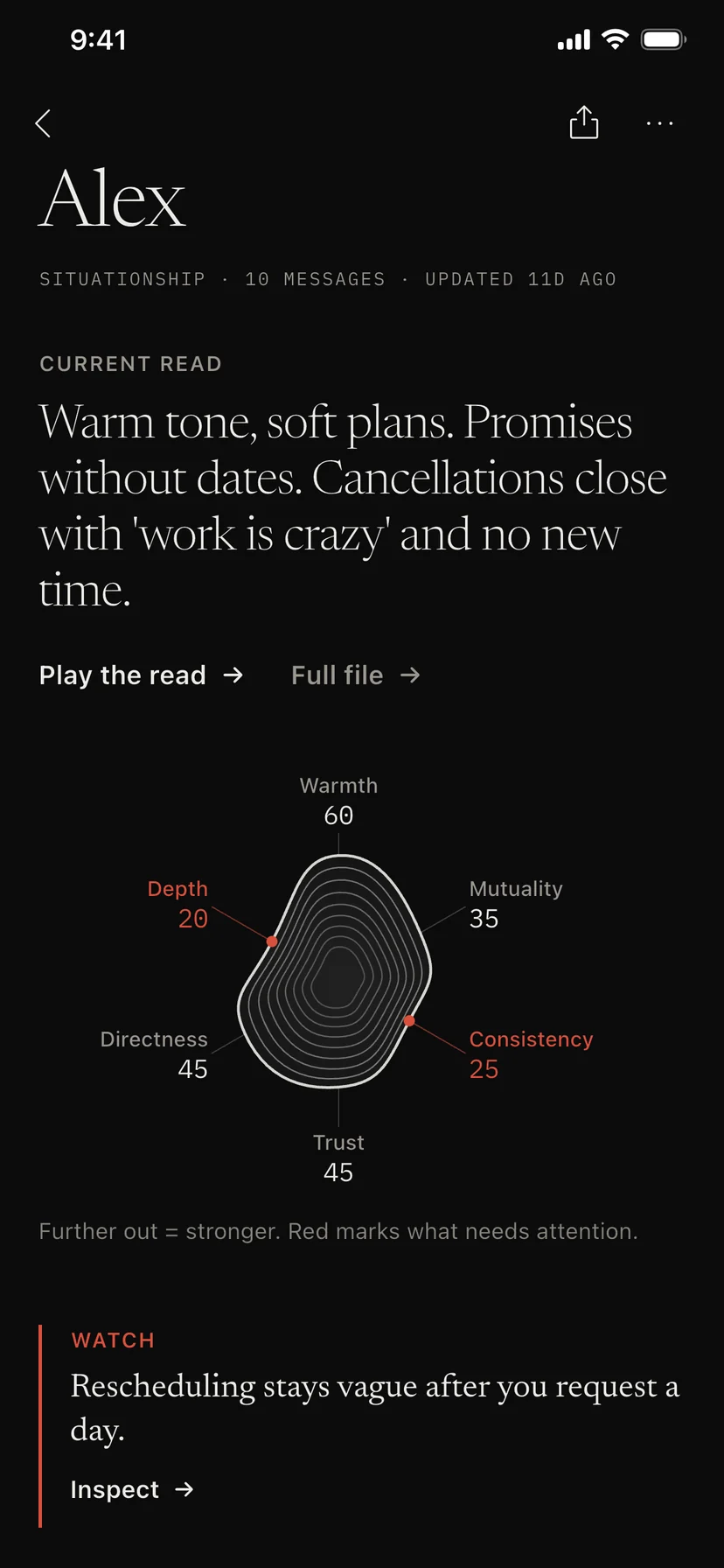
Vermilleon's read can name the loop the two of you keep running, with the messages behind each finding and what to say next. What to send then drafts two or three ways to name the loop or make the specific apology. Bring in a chat only if it's a conversation you're part of and the other person consents.

Questions people ask next
- How many times is too many before it counts as a real problem?
- A single fight is a moment; a repeating pattern with the same shape and no described next step is a loop worth naming. Count the repetitions rather than the intensity. One hard month isn't the same as a loop that has run for a year. Judge after you've named the pattern clearly two or three times and nothing has shifted, not after the first apology.
- How do I bring up the pattern itself without starting the same argument again?
- Choose a calm time, not during the fight. Name the shape, not the person: "I notice we end up here, and I don't think either of us is trying to." Then ask one specific question: "What do you want me to do differently next time?" This moves from content to process without assigning blame.
- Is it normal to have the same argument for years?
- Yes, and it's normal for it to stay painful. Many close relationships have a recurring fight that never fully resolves; what changes is repair. The question isn't whether you argue it, but whether you can get back on track after and whether the next round moves at all. If nothing shifts after you've named it clearly two or three times, that's separate information.
- Does needing to ask for the same thing twice mean they don't care?
- Not on its own. People miss bids, get flooded, or hold different defaults taught by their families. If you've asked for the same small thing twice and they've agreed but not changed, judge the next behavior, not the apology. Repeated agreement with no visible change is evidence about follow-through, not love.
- Should we stop talking about it and just move on?
- Only if the loop is truly small and the repair is easy. Letting go can be a repair method when the fight is about preference, not a repeating need. But if the same fight keeps returning, avoidance usually becomes another step in the loop. A better move is to name the process once and ask for one specific next-time behavior.
Sources
- R is for Repair, The Gottman Institute
- The Magic Relationship Ratio, According to Science, The Gottman Institute
- Turn Towards Instead of Away, The Gottman Institute
- The Four Horsemen: Criticism, Contempt, Defensiveness and Stonewalling, The Gottman Institute
- The Four Horsemen: Stonewalling, The Gottman Institute
- Types of Abuse, National Domestic Violence Hotline
Vermilleon Editorial · Published 23 Oct 2026 · How we write these →